The presidential candidate has signaled he will follow his father’s path: the absence (and destruction) of policies aimed at these territories and attacks on the traditional way of life
The son’s script promises to be the same as the father’s. When it comes to Indigenous lands, it is no different: dehumanization of Indigenous peoples, denial of the demarcation of traditional territories, and defense of agricultural and mining production inside them.
During the presidential campaign, Flávio Bolsonaro repeated statements about Indigenous peoples similar to those his father made during the years he led the federal Executive. And he signaled that he will follow the same path: the absence (and destruction) of policies aimed at these territories and attacks on the traditional way of life.
Flávio, like Bolsonaro, compares Indigenous people to animals. “They don’t want to be a zoo animal anymore,” he said in an interview, defending the economic exploitation of Indigenous territories by agriculture and mining.
During a visit to an agribusiness fair in Mato Grosso months ago, Flávio also reinforced that, like his father, he will not demarcate Indigenous lands. “If it’s up to our government, none of these reserves will be demarcated, because the State’s calling is production.”
On that occasion, the candidate also claimed there is an “ideological attempt” by the Lula government to “hinder” agribusiness. “There are Funai requests for demarcations of Indigenous reserves that could total 2,2 million hectares (5.4 million acres), affecting 22 municipalities in Mato Grosso. It’s unacceptable.”
He then spoke of “respecting the autonomy of Indigenous peoples.” He argued that they will be able to decide how to “exploit the lands and what needs to be done, whether it’s planting or mineral extraction, all with a lot of responsibility.”
Government platform
The defense of “economic autonomy” for Indigenous peoples is in the government platform Flávio submitted to the Superior Electoral Court (TSE). The text says that, in a possible administration of the PL candidate, Indigenous people and quilombolas will be able to decide on productive activities on their lands.
During his term, former president Jair Bolsonaro encouraged and politically supported agricultural production projects, especially soy, on Indigenous lands. These initiatives were carried out amid a series of illegalities and conflicts with environmental enforcement agencies.
According to the Federal Constitution, Indigenous lands belong to the Union and are therefore inalienable assets. This means they cannot be sold, donated, or leased. Today, these territories cover 13.8% of Brazil’s total area and hold about 20% of all of its native vegetation. That means they are responsible for preserving thousands of hectares of vegetation.
Subscribe to our newsletter in English and receive our stories straight to your inbox
Soy and corn
One of the measures Bolsonaro took to pave the way for soy and corn production on Indigenous lands was issuing a joint normative instruction from the National Indigenous Peoples Foundation (Funai) and the Brazilian Institute of Environment and Renewable Natural Resources (Ibama), now repealed. Planting began to be carried out through “partnerships” between Indigenous and non-Indigenous people. His government was marked by tensions within the two agencies, whose leadership was threatened with dismissal “so as not to get in the way of those who want progress.”
All of this was investigated by O Joio e O Trigo throughout 2022 and resulted in two series of reports and four podcast episodes. We made two major trips to Mato Grosso, where we witnessed Indigenous people adopting large-scale cultivation of soy and corn. In addition, we analyzed 10,000 pages of documents and conducted dozens of interviews to reveal a series of illegalities that the Bolsonaro government tolerated, encouraged, or promoted directly.
The investigation shows how soy is merely a symptom of something larger that has taken hold among some representatives of Indigenous peoples: the ideology of progress, with the dream of wealth, which comes to govern these territories.
One of the projects is Agro Xavante/Independência Indígena (Indigenous Independence), a partnership between farmers linked to the Rural Union of Primavera do Leste and the Xavante Indigenous people of Primavera do Leste, in Mato Grosso, in Brazil’s Central-West region. The venture, which received Bolsonaro’s blessing and had the support of Funai and the Mato Grosso state government, was responsible for the deforestation of 1,500 hectares of Cerrado to open a crop field in the Sangradouro territory in 2021.
The Joio investigation laid out the arguments for and against the project, along with its consequences:
- Deforestation and fines for illegal deforestation: the project led to the deforestation of 1,500 hectares of native Cerrado and was the target of Ibama embargoes and investigations.
- Internal division: the initiative caused division among community leaders, some of whom defended preserving the Cerrado while others supported the project, seduced by agribusiness’s ideology of progress.
- Disregard for Funai’s technical staff: Funai’s leadership under Jair Bolsonaro overrode opinions from its own technical staff and tried to lift the embargo on the illegal crop field.
- Lack of consultation with the population: the project advanced without due respect for community residents’ right to free, prior, and informed consultation, as established by Convention 169 of the International Labour Organization (ILO).
- Inequality in the agreements: the contracts provided that most of the production’s profits (about 80%) would go to the white partner producers, while a smaller share (20%) would go to the Indigenous people.
Dreams of wealth and profit
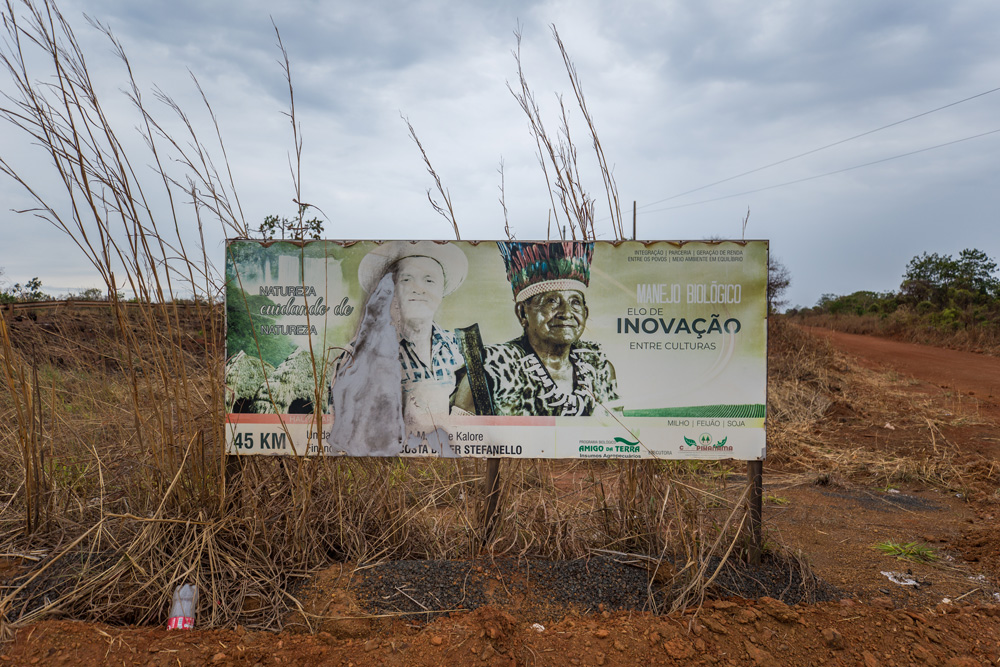
We also carried out an in-depth investigation into large-scale soy and corn production on the lands of the Pareci, Manoki, and Nambikwara in 2022. The project has existed since 2004 and was used by the Bolsonaro government to sell dreams of wealth to other Indigenous peoples.
Even today, Indigenous soy growers are trying to obtain environmental licensing to produce the grain on an area of 19,000 hectares. The initiative faces a lack of environmental authorization and Ibama embargoes due to deforestation and irregular commercial partnerships with non-Indigenous producers.
One of the leaders, Arnaldo Zunizakae, became a kind of poster boy for the defense of soy production on Indigenous lands and took part in events and livestreams with then-president Jair Bolsonaro. “Indians have the right to be like us,” he would say. He told Joio that, in just one year, he gave talks on the subject to representatives of 30 other Indigenous peoples in Brazil.
In the two series of reports mentioned above, we noticed the advance of an entrepreneurial and individualistic ideology that sees traditional ways of life as a reason for shame. Despite their pride, the Pareci themselves said they are “losing sleep” over debts incurred to cover production costs.
There are critics there too, but they are afraid to speak. What we heard is that there is a culture of silencing in the villages. Those who question the projects ask for anonymity. According to them, monoculture brings health impacts, pollution of rivers and water, and social inequality.
In August of this year, Flávio Bolsonaro visited a Pareci village. And once again he defended “autonomy” for Indigenous peoples to carry out economic activities on their lands. “You are an example of what we can do in other Indigenous communities.”
There is no doubt: Flávio’s project is to follow the policy of agricultural expansion over traditional territories, serving the interests of Brazilian and global agribusiness companies.